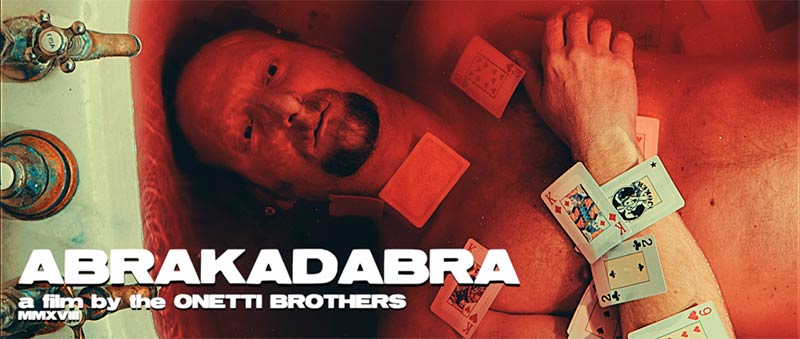
Business as usual here from the Onettis: impressive visuals, retro kitsch in a way that's not overly kitschy, and a story that a child could've written. It apparently brings their giallo trilogy (c.f. Sonno Profondo and Francesca) to a close, not that they'd have necessarily told you that Sonno Profondo was part of a trilogy back when they made it (although then again it's possible that all three films were written over the same pint of beer). To be honest, it's probably no bad thing to put a metaphorical full stop on this style of filmmaking; they're very good at it, but there's only so many times you can refine such an idiosyncratic style as theirs before you descend into parody (and, thankfully, that has not happened here, although they're teetering on the brink).
Lorenzo Mancini is haunted by the memory of his father's death in a magic trick gone wrong. He hasn't let the trauma prevent him from carrying on the family tradition though, and is boozing his way through a career as a touring magic act when we first see him. His preparations for a new show in Turin are interrupted by the discovery of a murdered woman on the stage before opening night. Remarkably, this doesn't seem to have any real effect on anything, as the show goes ahead as planned. A very attractive show attendee is then murdered, as is a lady with whom Mancini has engaged in a threesome. Someone's trying to frame him, and it seems to have something to do with a weird pendant which bears an 'Abrakadabra' inscription. It also has something to do with his father's ex-assistant, who spent 20 years behind bars for the aforementioned murder, but who claims on his death bed that he's innocent because he's Mancini's father's brother (i.e. Mancini's uncle). This is bizarre because a) why did he withhold this information for so long, and b) brothers can still kill each other (c.f. Cain and Abel). Anyway, there's also a detective who smokes and walks a lot and a sexy assistant and a lot of old phones. And, of course, some J&B.
First (and best) things first: the look of the film. Yet again, the Onettis go extremely heavy on the editing filters (check out the ungraded footage if you own the Blu ray to see just how different the raw material looks), but somehow it works. The saturated greens and reds look great, for the most part, and there's no fake scratches or added grain this time. The contrast is pushed to such an extent that this image is frequently washed out with white blotches, but this happens so often that you have to assume that it's a deliberate choice. The outdoor scenes, wherein this occurs most frequently, do somewhat evoke the feeling of an old 70s print which has lain undiscovered in an attic for years, encroaching vinegar eating away at the image detail. The film's never unwatchable, though - far from it - and the dubbing and sound effects are on a par with the previous two films, as is the soundtrack (which is still lacking in nuance and quieter moments, but which nonetheless evokes old Bruno Nicolai and Ennio Morricone scores with great élan).
The acting is serviceable, again on a par with the previous Onetti films, and the faces of the actors are extremely well-chosen; you'd believe that any of them could have walked out of an early 70s Martino film (although it's fascinating to see how natural evolution has changed the shape of women's upper lips in the past 50 years, and one victim's tattoos and hairstyle weren't very 70s [her willingness to disrobe is, however, redolent of 70s actresses]).
Some of the locations are excellent - the Onettis make decent use of the theatre location, and some drone shots showcase the 'Turin' architecture brilliantly. (There are a lot of overhead/high angle shots in the film in fact, no doubt inspired by recent Irish gialli.) We get a return to their old favourite location - the graveyard, which, as per, they shoot in blinding sunlight. The chase sequence they stage here, involving Mancini sprinting from the detective figure, who strolls casually but menacingly after him, never seeming to lose ground, serves as both a parody of the preponderance of such scenes in slasher films and as a cheeky clue as to what's really going on here.
Because, yes, there is a story here - someone's killing people and trying to frame Mancini. There's a very slight nod of the head at the concept of an investigation by Mancini, but mostly the film consists of dialogue free mood sequences driven by cinematography and music. This is probably a sensible approach for no budget filmmakers - forget about the technicalities of live sound recording and focus on doing one thing (cinematography) well, and use your composing skills to fill in the gaps later on (it helps if you're also a very talented composer). As I've suggested above there's not a huge amount going on plotwise (although there is a concluding twist which I'm fairly sure has never been done before), and the film, and the Onettis' universe as a whole, is probably tangentially-related to the Cattet-and-Forzani-sphere, albeit the Onettiverse isn't completely starved of oxygen and vitality; the camera bumps and jerkily zooms around, the corpses breathe and the passion is evident throughout, whereas the refinement process to which the Belgians' world has been subjected has rendered it devoid of vitality.
Keep an eye out for the newspaper stories that are used throughout and have no relationship whatsoever to the headlines - I think that's probably a deliberate choice, as that did and does happen in other films, but it's quite something to see a snatch of an article about Bobby Fischer playing chess under a headline about a murder. The English-language inserts, in fact, are another example of the dedication of the brothers to giallo verisimilitude (which is often diametrically opposed to actual verisimilitude, AKA real life). And so, as you watch the typically lengthy closing credit sequence (which does at least contain more than two names) play over a poor Poor Man's Process shot, raise a glass of J&B to these Argentinian workhorses for their three fine films, but please, if you're a rich scriptwriter, write their next giallo for them, and throw them a bit of scratch for the budget.
IF YOU find a box of matches from a bar it's definitely a key clue and you should head to that bar immediately on the assumption that whoever lost them will be there Right Now.
Lorenzo Mancini is haunted by the memory of his father's death in a magic trick gone wrong. He hasn't let the trauma prevent him from carrying on the family tradition though, and is boozing his way through a career as a touring magic act when we first see him. His preparations for a new show in Turin are interrupted by the discovery of a murdered woman on the stage before opening night. Remarkably, this doesn't seem to have any real effect on anything, as the show goes ahead as planned. A very attractive show attendee is then murdered, as is a lady with whom Mancini has engaged in a threesome. Someone's trying to frame him, and it seems to have something to do with a weird pendant which bears an 'Abrakadabra' inscription. It also has something to do with his father's ex-assistant, who spent 20 years behind bars for the aforementioned murder, but who claims on his death bed that he's innocent because he's Mancini's father's brother (i.e. Mancini's uncle). This is bizarre because a) why did he withhold this information for so long, and b) brothers can still kill each other (c.f. Cain and Abel). Anyway, there's also a detective who smokes and walks a lot and a sexy assistant and a lot of old phones. And, of course, some J&B.
First (and best) things first: the look of the film. Yet again, the Onettis go extremely heavy on the editing filters (check out the ungraded footage if you own the Blu ray to see just how different the raw material looks), but somehow it works. The saturated greens and reds look great, for the most part, and there's no fake scratches or added grain this time. The contrast is pushed to such an extent that this image is frequently washed out with white blotches, but this happens so often that you have to assume that it's a deliberate choice. The outdoor scenes, wherein this occurs most frequently, do somewhat evoke the feeling of an old 70s print which has lain undiscovered in an attic for years, encroaching vinegar eating away at the image detail. The film's never unwatchable, though - far from it - and the dubbing and sound effects are on a par with the previous two films, as is the soundtrack (which is still lacking in nuance and quieter moments, but which nonetheless evokes old Bruno Nicolai and Ennio Morricone scores with great élan).
The acting is serviceable, again on a par with the previous Onetti films, and the faces of the actors are extremely well-chosen; you'd believe that any of them could have walked out of an early 70s Martino film (although it's fascinating to see how natural evolution has changed the shape of women's upper lips in the past 50 years, and one victim's tattoos and hairstyle weren't very 70s [her willingness to disrobe is, however, redolent of 70s actresses]).
Some of the locations are excellent - the Onettis make decent use of the theatre location, and some drone shots showcase the 'Turin' architecture brilliantly. (There are a lot of overhead/high angle shots in the film in fact, no doubt inspired by recent Irish gialli.) We get a return to their old favourite location - the graveyard, which, as per, they shoot in blinding sunlight. The chase sequence they stage here, involving Mancini sprinting from the detective figure, who strolls casually but menacingly after him, never seeming to lose ground, serves as both a parody of the preponderance of such scenes in slasher films and as a cheeky clue as to what's really going on here.
Because, yes, there is a story here - someone's killing people and trying to frame Mancini. There's a very slight nod of the head at the concept of an investigation by Mancini, but mostly the film consists of dialogue free mood sequences driven by cinematography and music. This is probably a sensible approach for no budget filmmakers - forget about the technicalities of live sound recording and focus on doing one thing (cinematography) well, and use your composing skills to fill in the gaps later on (it helps if you're also a very talented composer). As I've suggested above there's not a huge amount going on plotwise (although there is a concluding twist which I'm fairly sure has never been done before), and the film, and the Onettis' universe as a whole, is probably tangentially-related to the Cattet-and-Forzani-sphere, albeit the Onettiverse isn't completely starved of oxygen and vitality; the camera bumps and jerkily zooms around, the corpses breathe and the passion is evident throughout, whereas the refinement process to which the Belgians' world has been subjected has rendered it devoid of vitality.
Keep an eye out for the newspaper stories that are used throughout and have no relationship whatsoever to the headlines - I think that's probably a deliberate choice, as that did and does happen in other films, but it's quite something to see a snatch of an article about Bobby Fischer playing chess under a headline about a murder. The English-language inserts, in fact, are another example of the dedication of the brothers to giallo verisimilitude (which is often diametrically opposed to actual verisimilitude, AKA real life). And so, as you watch the typically lengthy closing credit sequence (which does at least contain more than two names) play over a poor Poor Man's Process shot, raise a glass of J&B to these Argentinian workhorses for their three fine films, but please, if you're a rich scriptwriter, write their next giallo for them, and throw them a bit of scratch for the budget.
IF YOU find a box of matches from a bar it's definitely a key clue and you should head to that bar immediately on the assumption that whoever lost them will be there Right Now.
 RSS Feed
